
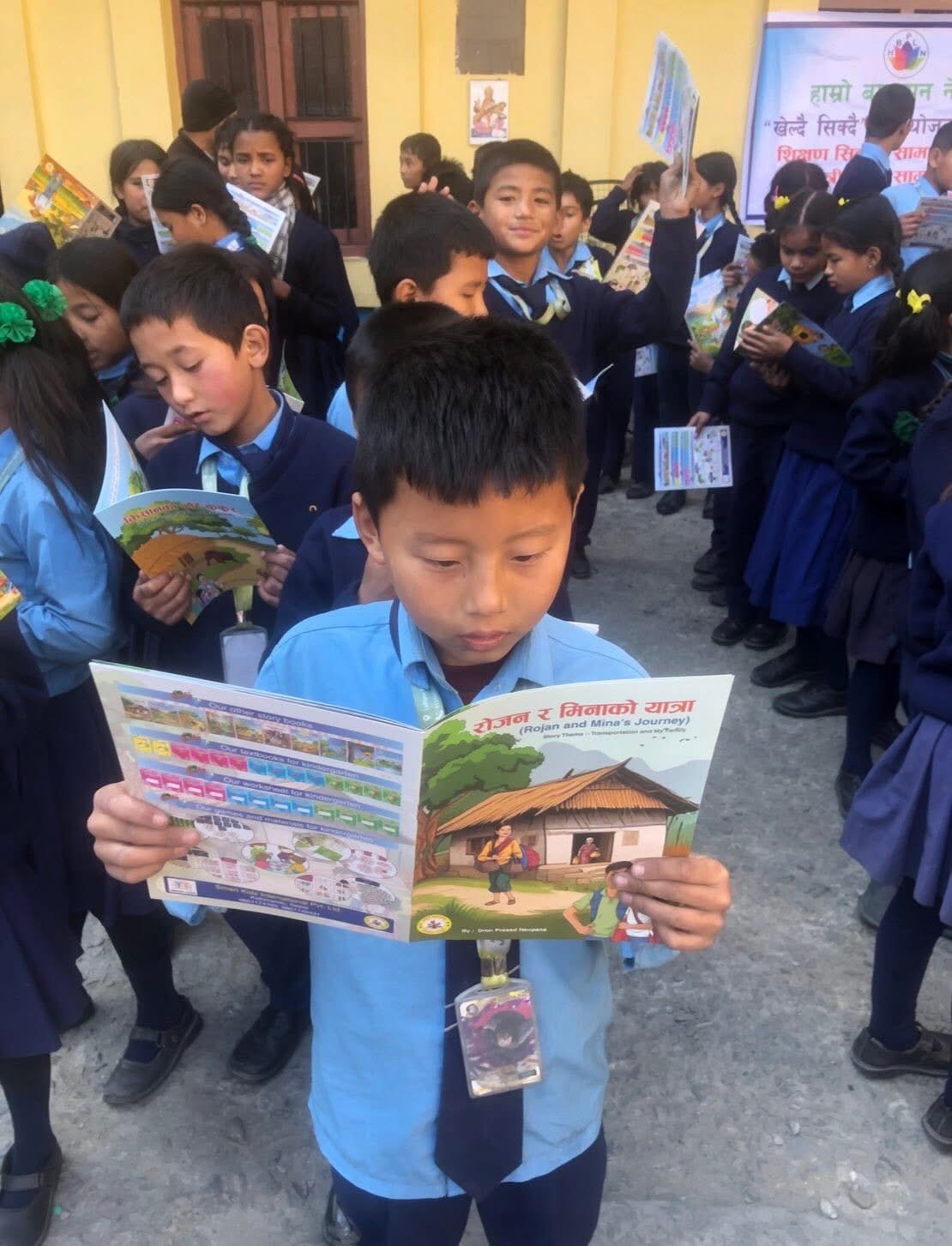
Child Friendly Playing Materials and Reading Materials Distributions
Importance of Play on Early Childhood Developments
Naturally children love to play rather reading and writing, copying looking on the board and following all the strict schools’ rules. From different games they learn in enjoyable environments. All teaching-learning activities should include children’s: social, cognitive, physical, emotional aspect of holistic development approach of children.
Parents, teachers, schools are mainly responsible to provide holistic developmental activities inside the home, schools and classroom. Play-Based Methods of teaching the children possess potentiality of holistic development activities on contradictory to traditional monotonous teaching-learning process like reading loud, writing, copying board written contains.
While playing games; children learn re- arrangements, re- adjustment re- organizing, problems solving by themselves enjoying even after distorting and demolition. Games Even develops children’s intellectual capabilities and creative horizon. Children familiarized with objects around them, identify nature, have acknowledge about environment, relationship among themselves and objects, nature, environment, its cause and effects; all these gives scientific knowledge. Through playing games children learnt to identify shapes, types, color of objects which enhance mathematical understanding. Children interact within groups, they question like what, where, how, when, why etc. from which their language Competency develops.
On course of playing games children runs, hops, dragged, rolls, jumps, pulls, pushes, which develops their gross – motors functions. Some classrooms in-door games like Blocks, Legos, Memory games, Cards Games etc. Develops eye -hand co-ordination for the children fine motor skills which helps in holding pens and ultimately develops body and bodily activities.
Playing games children learns sharing, turn taking, following the rules of the games, co-operation, co-ordination, responding, acting, inter-acting, questioning- answering, role playing, leading, problems solving, emotional values, social values, communal values, relationship, faith, believes, culture, custom among themselves which develops their social understanding.
When children play games, they sometime win and sometime lose from that they learn to control themselves in different situations. Life is not always about winning; sometimes one can also lose so in failure, weakness Children learn to respond calmly and improve to overcome failure in next attempts. They express their feelings with other friends, find out the weakness, express their emotions, ideas, likes, dislikes, personal opinion, thought, views all these help them to develops emotionally.
Naturally children love to play, enjoy while learning through games. Play – way methods are the effective medium to teach for two years to eight years children. Children may forget after a while on memorizing from books or writing in copy but can easily learn through touching, re-arranging, distorting, observing, mixing, coloring, handling, holding, tearing, pasting, sequencing by their own hands with participating and self-involving.
This age group is naturally the age that loves to play. Through this project, children will acquire thematic knowledge and skills through playing with play materials. According to the developmental stage of children, this age is also considered the age of laying the foundation. The holistic development of children (social development, emotional development, mental development and physical development) is achieved through the play method. This project is very important for child development and learning.
According to a statement published by the Education and Human Resource Development Center (Early Childhood Development Branch), Sano Thimi, Bhaktapur, Government of Nepal on 2079/9/25, the age from pregnancy to 8 years this is a time of early childhood development and children of this age group need to be more involved in activities that promote holistic development. Policies and programs of Nepal Government, has provided clear guidance on conducting development and learning activities, evaluating and standardizing development and learning process. Accordingly, arrangements have been made for a child development center for children under the age of 4 and a 1-year early childhood development and education program for the holistic development of children between the ages of 4 and 5. It has been decided that activities for the holistic development of children should be given more priority in the pre-primary classes of Montessori and institutional schools established according to the concept of Child Development Centers. It has been decided that child-friendly play equipment should be mandatory in pre-primary classes of every Montessori and institutional school. Despite the policy framework in our 21 years long work experiences indicate that there are various problems are lagging the holistic development of children. To solve this problem Hamro Balapan Nepal going to provide training to teacher and parents with the necessary teaching are learning material.
National Education Policy 2076, Compulsory and Free Education Act, 2075 and its Regulations 2077, Education Act 2028 and Regulations 2059, National Curriculum Framework for School Education 2076, Early Childhood Development and Education Curriculum 2077 and Basic Level (Grades 1 to 3) Curriculum 2076 Child Development Center, Early Childhood Development/Pre-Primary Education and Admission of Children to Basic Level (Grades 1 to 3)